As AI servers continue moving from 4U to 8U and beyond, thermal management is no longer limited by heat dissipation capacity alone.
A more fundamental challenge is working fluid return capability.
Many conventional heat pipe solutions perform well at moderate power levels. However, when heat flux continues increasing and transport distance becomes longer, the liquid return path often becomes the limiting factor.
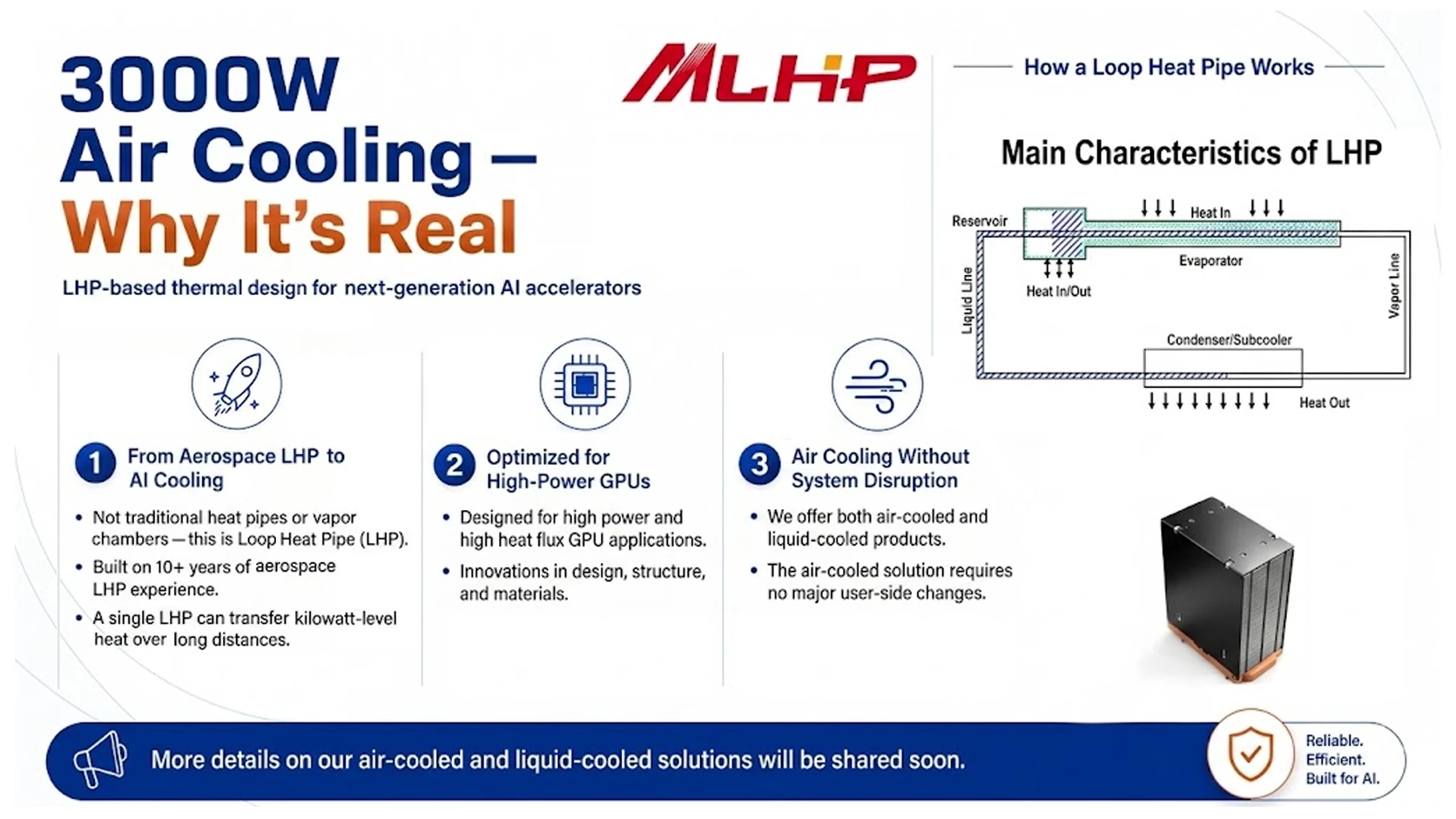
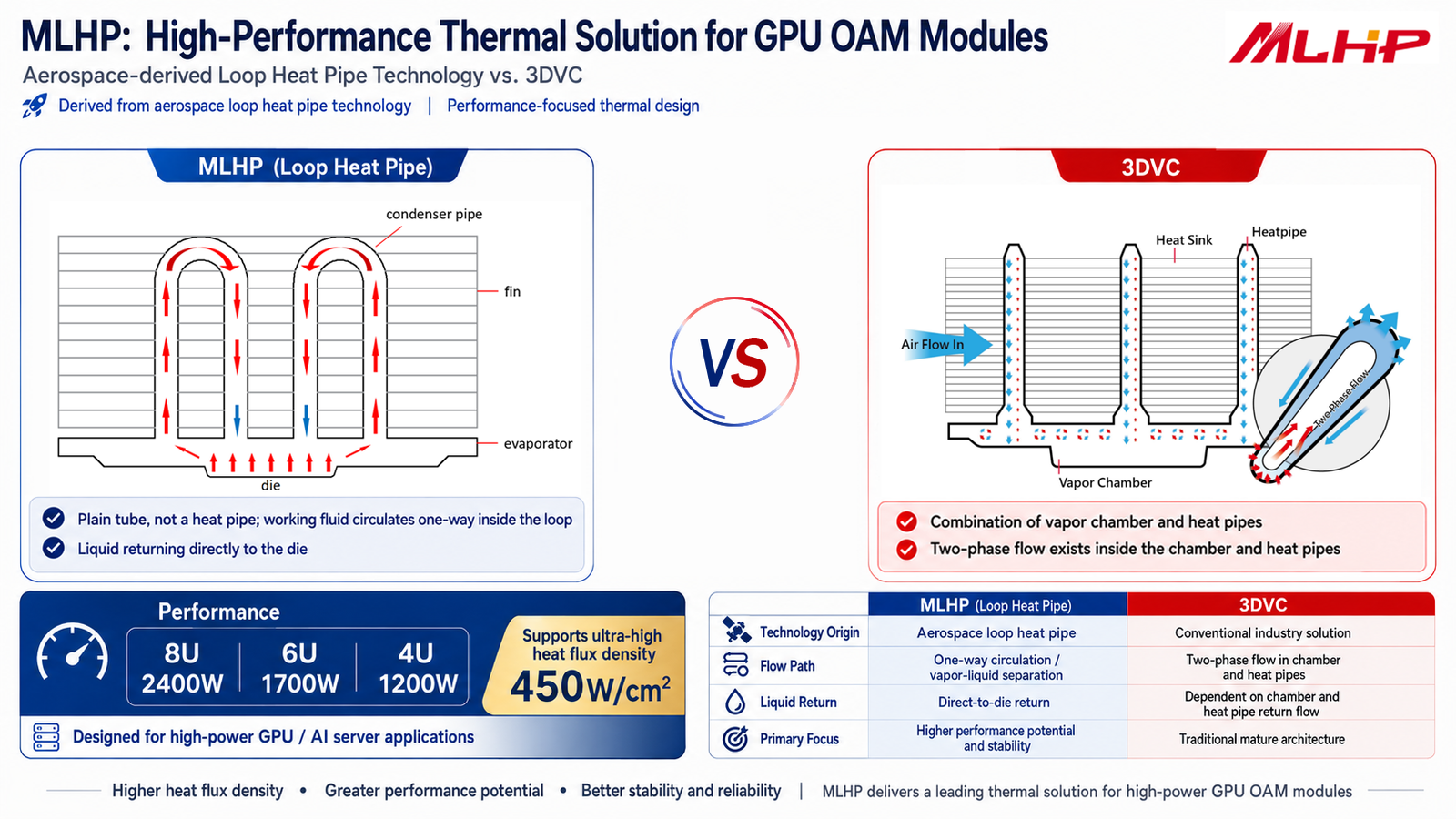
This is where the fundamental difference between Loop Heat Pipes (LHP) and Traditional Heat Pipes (HP) becomes critical.
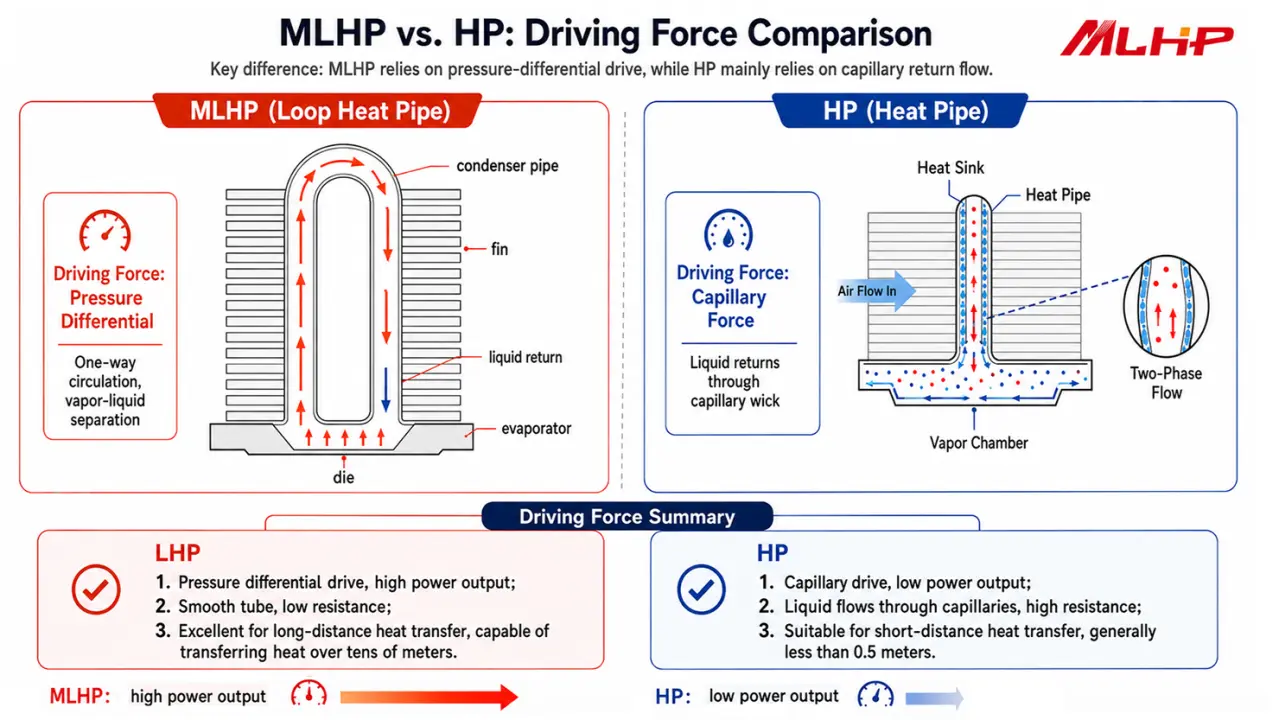
The Driving Force Difference
Traditional Heat Pipe (HP)
A traditional heat pipe primarily relies on capillary force generated by the wick structure inside the pipe.
After vapor condenses into liquid, the liquid must travel back to the evaporation zone through microscopic capillary channels.
Key Characteristics:
- Liquid return depends on capillary pumping
- Liquid flows inside porous wick structures
- Higher flow resistance
- Performance becomes increasingly sensitive to transport distance and orientation
As system size increases, the liquid return process becomes slower and more difficult, especially under high heat flux conditions.
Loop Heat Pipe (LHP)
A Loop Heat Pipe operates through a different mechanism.
Instead of relying primarily on capillary liquid transport through the entire loop, LHP utilizes a pressure differential driven circulation mechanism.
The evaporator maintains a higher pressure while the condenser remains at a lower pressure, creating a continuous pressure-driven circulation loop.
Key Advantages:
- Pressure-differential driven circulation
- Separate vapor and liquid flow paths
- Smooth transport lines with extremely low flow resistance
- Stable long-distance heat transport capability
Because the working fluid returns through dedicated liquid lines rather than flowing through long wick structures, liquid return remains efficient even across much larger transport distances.
Why This Matters for AI Servers
Modern AI servers are facing increasingly demanding thermal challenges:
- GPU power continues rising
- Heat flux density keeps increasing
- Rack heights expand from 4U toward 8U, 10U, and beyond
- Thermal transport distances become longer
Under these conditions, slow liquid return can lead to:
- Local dry-out near the chip die area
- Reduced thermal performance
- Increased reliability risks
Loop Heat Pipes are naturally better suited to these challenges because their pressure-driven circulation mechanism maintains stable working fluid replenishment even under high power loads.
As power density increases, the advantages of LHP architecture become increasingly apparent.
The Key Takeaway
The difference between HP and LHP is not simply about cooling capacity.
It is about how the working fluid moves.
Traditional Heat Pipe (HP)
Capillary-force driven return flow through wick structures.
Loop Heat Pipe (LHP)
Pressure-differential driven circulation with dedicated vapor-liquid separation.
This fundamental difference explains why Loop Heat Pipes are becoming a compelling thermal architecture for:
- Next-generation AI servers
- High-density GPU systems
- Long-distance passive two-phase cooling applications
The Future of High-Power Thermal Management
As computing power continues to grow, thermal systems must evolve as well.
In many high-power scenarios, the future may belong to pressure-driven two-phase cooling architectures.
MLHP technology enables passive two-phase cooling solutions capable of supporting kilowatt-class chip thermal management while maintaining:
- Exceptional reliability
- Zero pump power consumption
- Long-distance heat transport capability
Conclusion
For traditional heat pipes, increasing power density and transport distance can create limitations due to capillary-driven liquid return.
Loop Heat Pipes overcome these challenges through pressure-driven circulation and separated vapor-liquid pathways.
This makes LHP technology a promising solution for future AI servers, high-performance computing systems, and other high-power thermal management applications.